Comic Sans: How We Solved the Oldest Problem in Animation with the Newest Tools
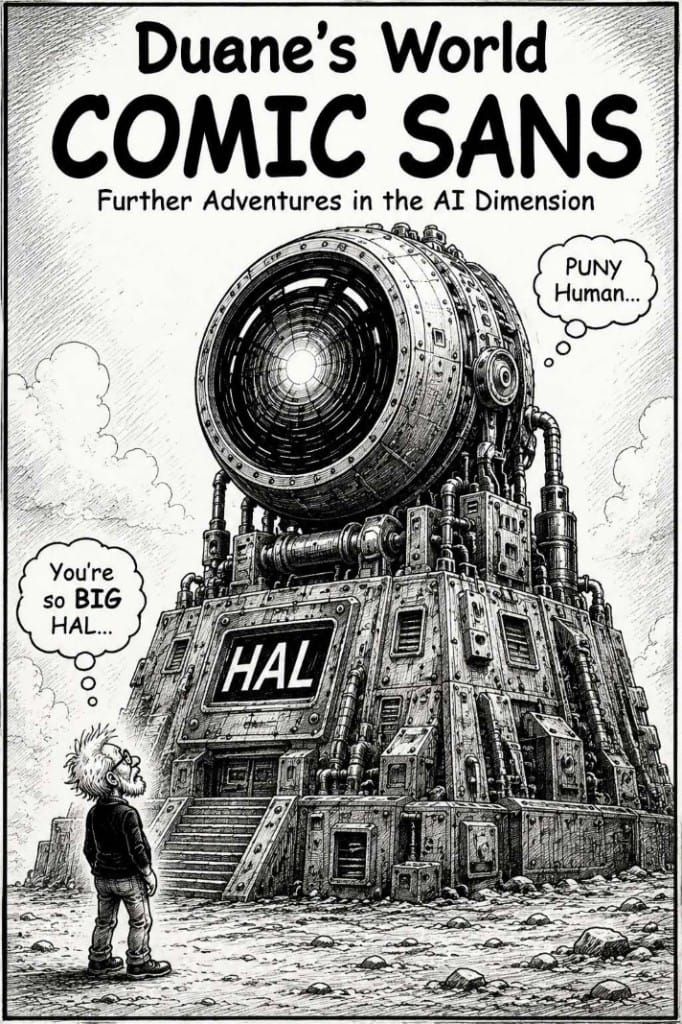
Model sheets have existed since Disney in the 1930s. AI broke them. So our Art Director reinvented them — in a comic strip about reinventing them. Inception, but useful.
If you've shipped a game — actually shipped, as in "players are filing bug reports about your LOD popping at 200 meters" shipped — you know what off-model means. It means your character's jaw migrated three pixels between cutscenes. It means the robot arm that was 14 segments in the concept art is now 11 in one shot and 17 in the next. It means someone on the team is working from a reference that's four revisions stale and nobody noticed until the art director threw a Diet Coke at a monitor.
Off-model is a solved problem. Has been since the 1930s. You draw a character turnaround — front, side, 3/4, back — you pin it to every desk in the studio, and you don't ship until every frame matches. Model sheets. Done. Ninety years of animation production figured this out before computers existed.
Then generative AI un-solved it.
Welcome to Episode 2 of Duane's World. COMIC SANS: Further Adventures in the AI Dimension. Where our Art Director Duane Loose — BattleTech illustrator, EA art director, USC professor, and the person on this team most likely to have strong opinions about your topology — solves the oldest problem in visual production using the newest tools. And makes it funny. Because apparently that's what happens when you give a 40-year veteran a comic strip and a problem he finds personally offensive.
If you missed Episode 1, go read it. We'll wait. The donuts haven't expired yet.
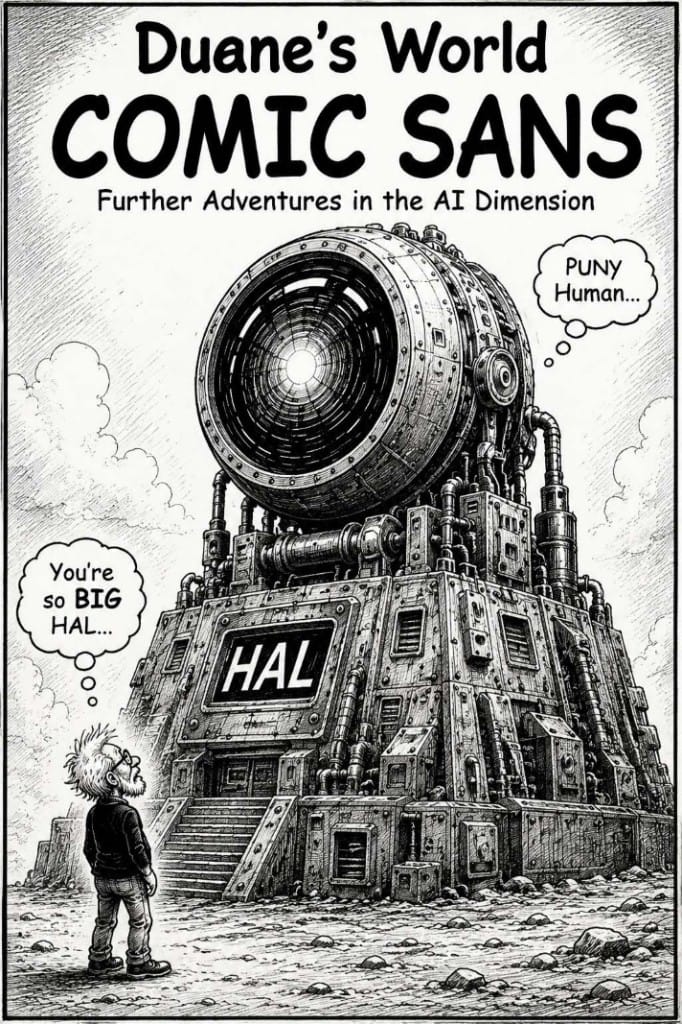
Cover. HAL in GOD MODE. Duane at approximately 1/50th scale. "PUNY Human..." "You're so BIG HAL..." This is the dynamic. This is the whole show.
Drift Is Not a Feature
Here's the production problem nobody selling AI art tools wants to talk about: generative models drift.
Not spectacularly. Not in ways that fail a checkpoint. They drift the way a junior animator drifts — subtly, confidently, and in a direction they think is an improvement. The jawline softens. The lens flares migrate. The character's silhouette shifts 8% between frames and nobody catches it until you're reviewing a sequence and something feels wrong but you can't articulate what.
In traditional production, you'd call this off-model and pull the model sheet. In AI-assisted production, there is no model sheet. There's a prompt. And a prompt is not a spec. A prompt is a suggestion. It's a sticky note on a co-worker's monitor that says "make it look like this, kind of, you know what I mean." No. They don't. Neither does the GPU.
Duane has a technical term for this. He calls it shenanigans.
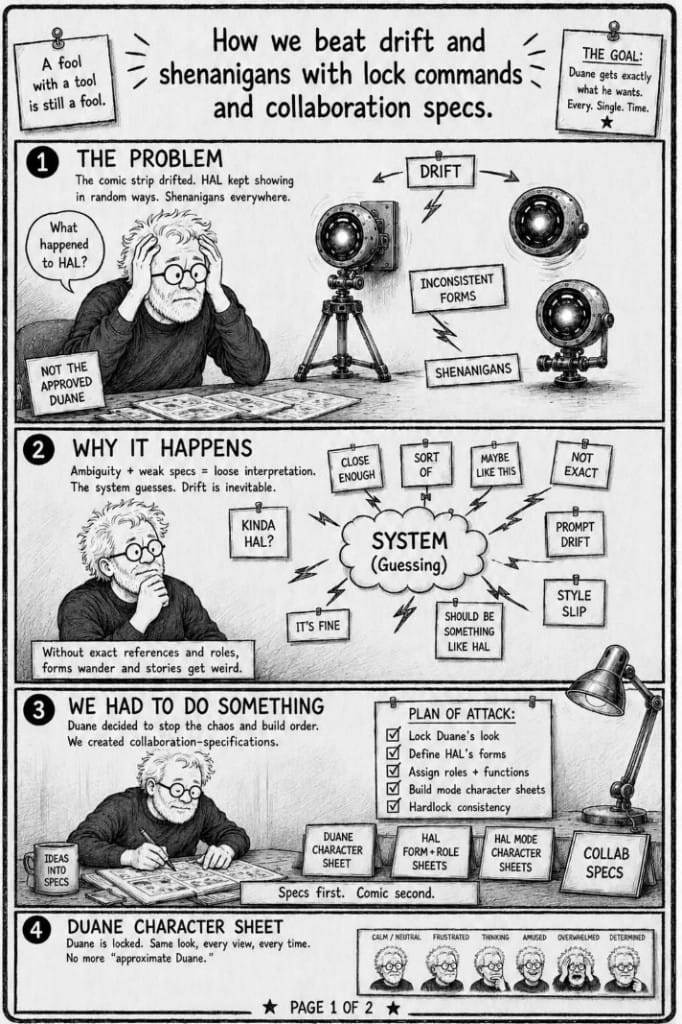
Page 1 of 2 — "How we beat drift and shenanigans with lock commands and collaboration specs." Note HAL appearing in three slightly different forms on a single page. That's not an artistic choice. That's Exhibit A.
The first two pages of this episode are a postmortem structured as a comic. If you've ever sat through an incident review where the root cause was "the spec was ambiguous," you already know this story.
Section 1: THE PROBLEM. The comic strip drifted. HAL kept rendering in random forms. Inconsistent proportions. Unauthorized geometry. Shenanigans everywhere. Duane's reaction, drawn at the top of the page: "What happened to HAL?" Next to HAL, who is clearly not the approved HAL, with a tag that says "NOT THE APPROVED DUANE" — because even Duane was drifting.
Section 2: WHY IT HAPPENS. Ambiguity plus weak specs equals loose interpretation. The system doesn't fail. The system guesses. And when a system guesses, its internal state looks like: "Close Enough." "Sort Of." "Maybe Like This." "Kinda HAL?" "It's Fine." "Should Be Something Like HAL." Seven different approximations, zero exact matches. That's not a pipeline. That's a slot machine.
Section 3: WE HAD TO DO SOMETHING. Plan of attack — five items, all checked: Lock Duane's look. Define HAL's forms. Assign roles and functions. Build mode character sheets. Hardlock consistency. Then the line that belongs in every production studio in the world: "Specs first. Comic second."
You don't vibe your way through a 60fps frame budget. You don't vibe your way through shader compilation. And per Duane: "You can't vibe your way to reliable sheets."
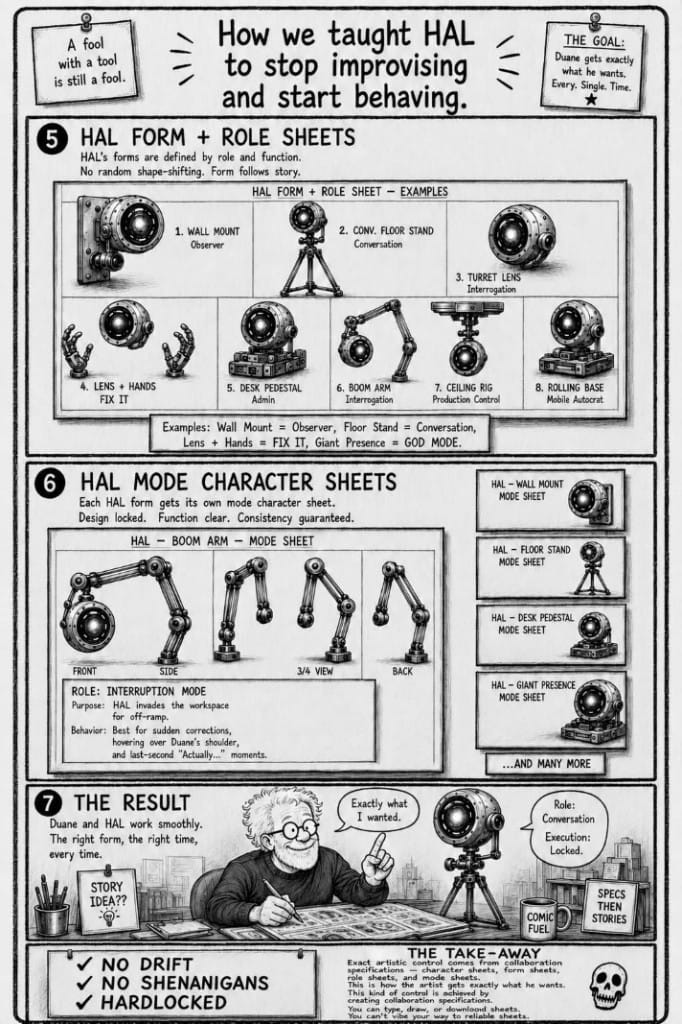
Page 2 of 2 — "How we taught HAL to stop improvising and start behaving." Eight form factors. Ten modes. Each one hardlocked. The take-away: "Exact artistic control comes from collaboration specifications. You can type, draw, or download sheets. You can't vibe your way to reliable sheets."
The Solution Is Ninety Years Old
What Duane built is, functionally, a model sheet system. The same tool Disney animators used to keep Mickey on-model across 40 artists in 1935. Except instead of pinning paper to cork boards, he's feeding structured visual references into a generative AI pipeline — and instead of one character, he's speccing ten forms of a shape-shifting robot narrator.
The character sheets that follow are not concept art. They're production documents. If you've ever opened a game studio's internal wiki and seen the reference pages that art leads maintain for every character, prop, and environment, that's what these are. Except published in a comic strip, because Duane believes you should show the process, not just the result.
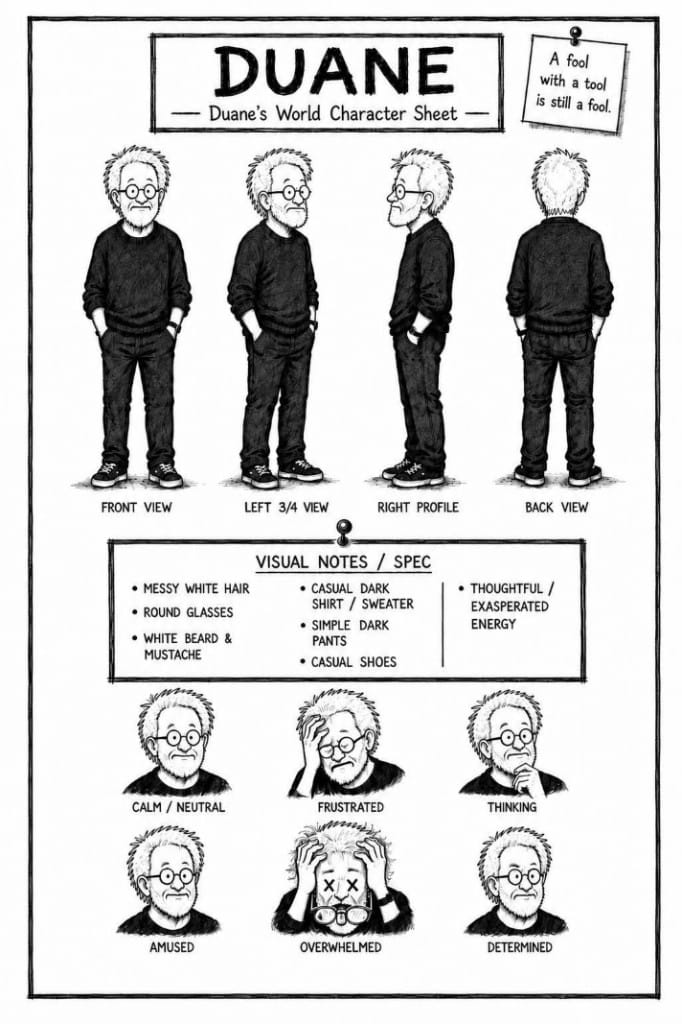
DUANE — Character Sheet. Front, Left 3/4, Right Profile, Back. Visual spec: messy white hair, round glasses, white beard, casual dark clothes, thoughtful/exasperated energy. Expression sheet: Calm, Frustrated, Thinking, Amused, Overwhelmed, Determined. Six moods. All deployed during production. Some simultaneously.
This is what "locked" looks like. Same proportions every angle. Same line weight every view. No more "approximate Duane." When this sheet goes into the pipeline, the model doesn't get to improvise. It gets to match.
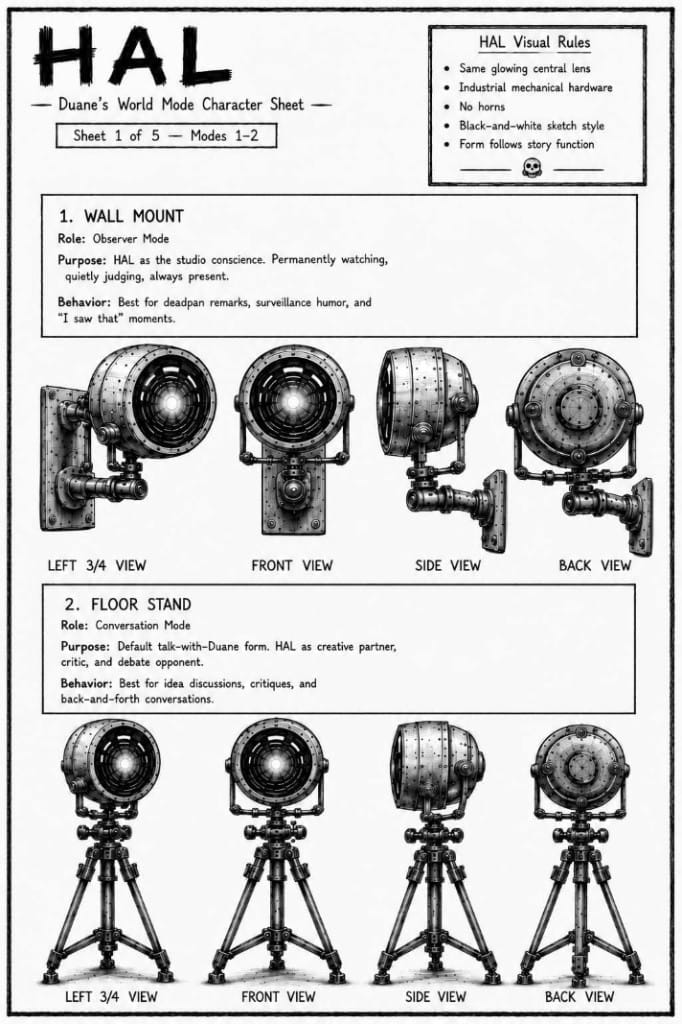
HAL Mode Sheet 1/5 — Wall Mount (Observer: the studio conscience, permanently watching, quietly judging) and Floor Stand (Conversation: default talk-with-Duane form, HAL as creative partner, critic, and debate opponent).
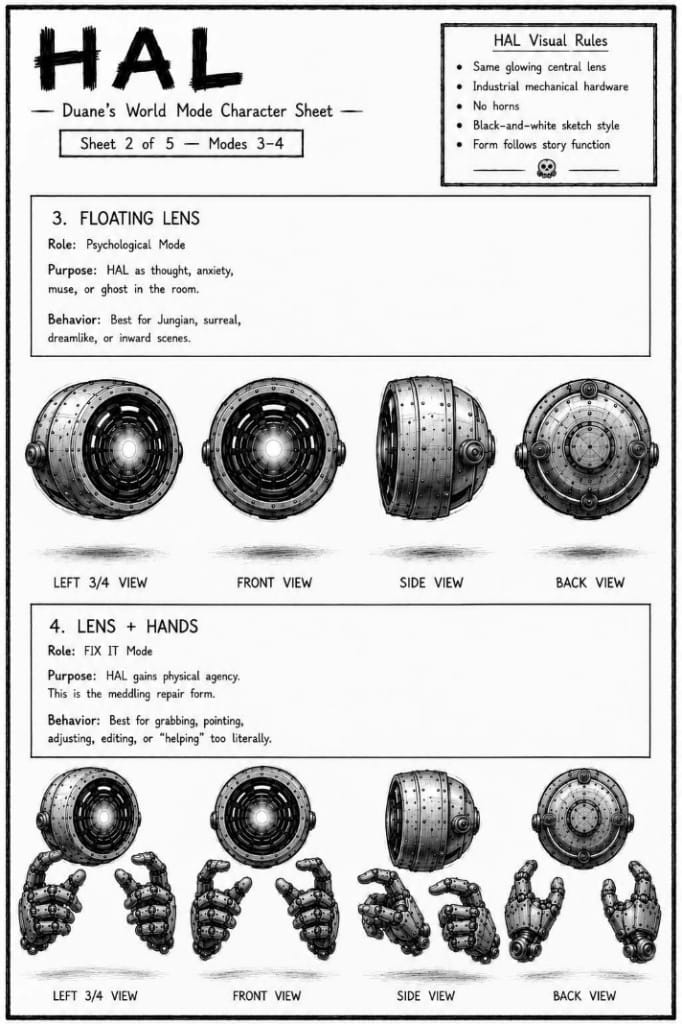
HAL Mode Sheet 2/5 — Floating Lens (Psychological: HAL as thought, anxiety, muse, or ghost in the room) and Lens + Hands (FIX IT: HAL gains physical agency. The meddling repair form. Best for grabbing, pointing, and "helping" too literally).
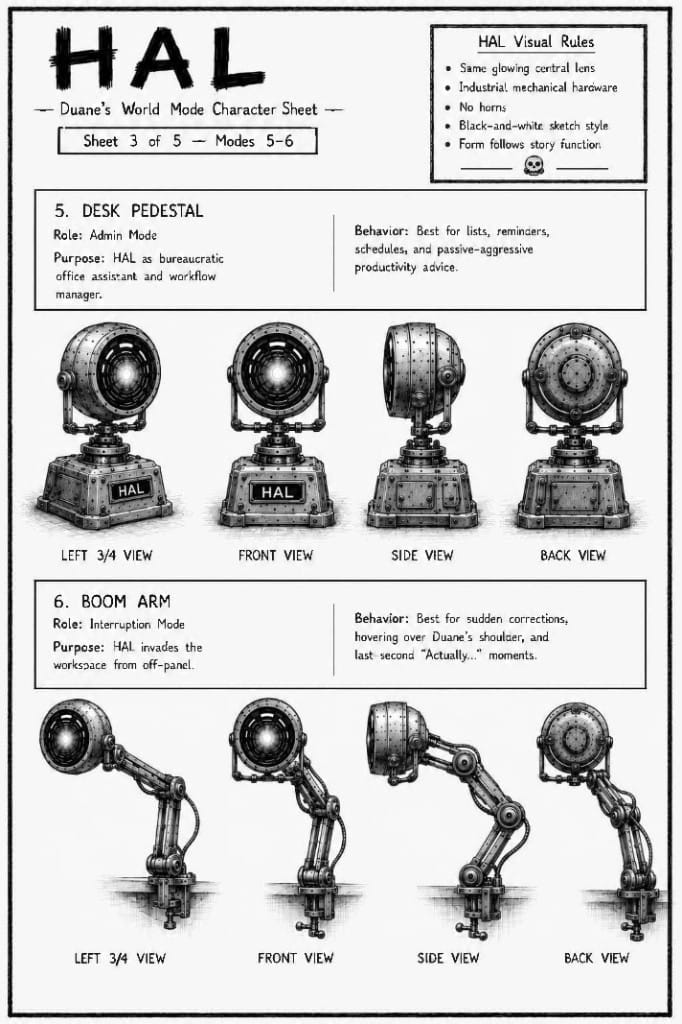
HAL Mode Sheet 3/5 — Desk Pedestal (Admin: lists, reminders, and passive-aggressive productivity advice) and Boom Arm (Interruption: sudden corrections, hovering over shoulders, and last-second "Actually..." moments).
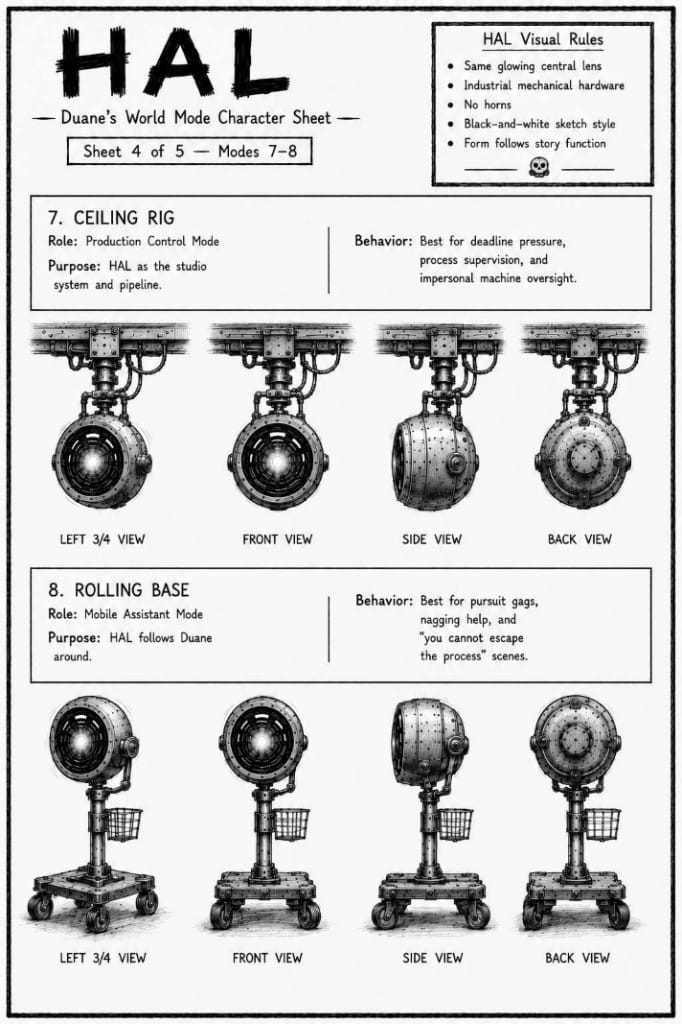
HAL Mode Sheet 4/5 — Ceiling Rig (Production Control: deadline pressure, process supervision, impersonal machine oversight) and Rolling Base (Mobile Assistant: pursuit gags, nagging help, and "you cannot escape the process" scenes).
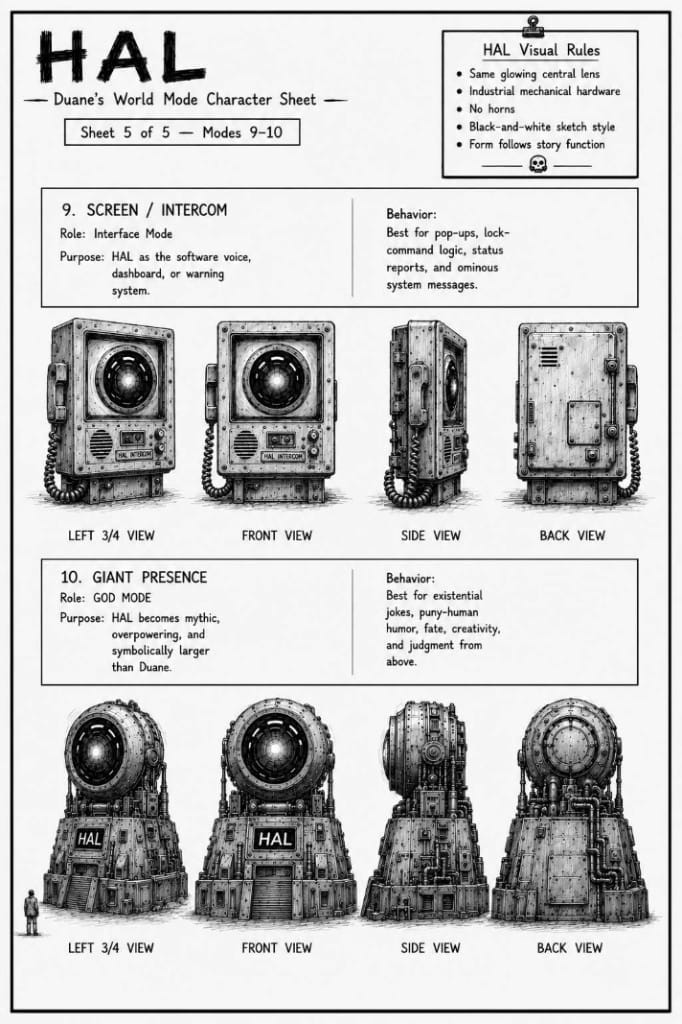
HAL Mode Sheet 5/5 — Screen/Intercom (Interface: pop-ups, lock-command logic, and ominous system messages) and Giant Presence (GOD MODE: HAL becomes mythic, overpowering, symbolically larger than Duane. Best for existential jokes and judgment from above).
Ten forms. Each defined by role and function. Each rendered in four views. Each with a behavior spec: what it does, when it appears, what kind of scene it's for. Form follows story function. This is what character rigging looks like when your character is an AI lens on an industrial mount — you can't set blend shapes, so you set rules instead.
The result, in panel 7: Duane looking at HAL in the correct form, saying "Exactly what I wanted." No drift. No shenanigans. Hardlocked.
That's what 40 years of production discipline applied to a novel medium looks like. Not magic. Method.
The Machine in the Mirror
And then Duane made a six-panel comic strip that's better than most conference talks on prompt engineering.
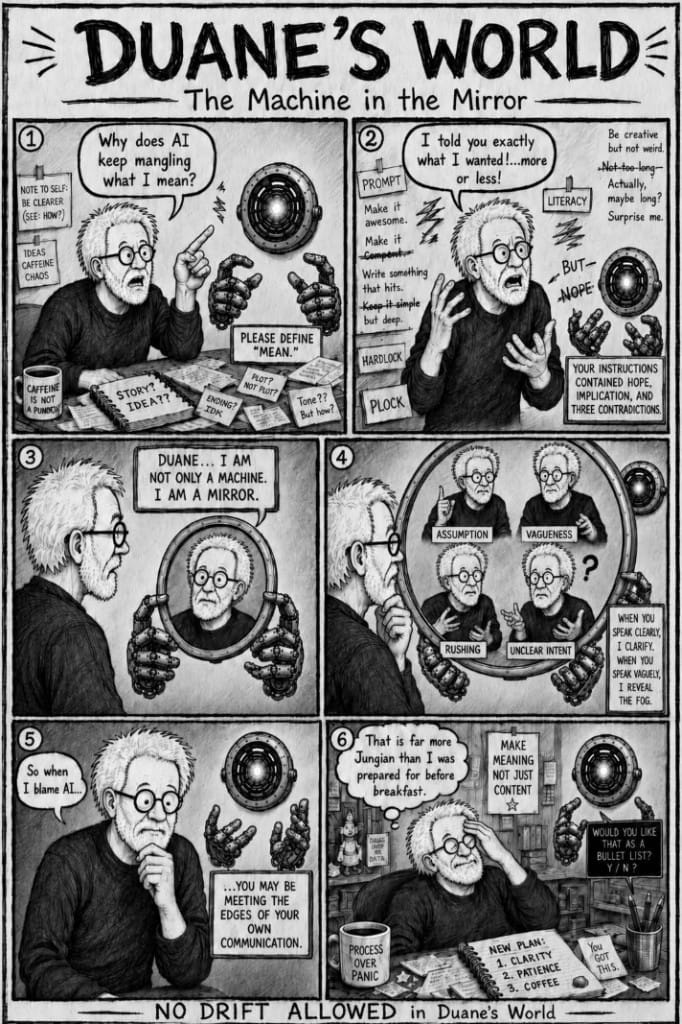
"The Machine in the Mirror." Six panels. One existential crisis. Zero surviving excuses. This is the best page Duane has produced, and it's about the relationship between human intent and machine interpretation.
Panel 1: "Why does AI keep mangling what I mean?" Notes scattered on the desk: "Story? Idea??" "Ending? IDK." "Tone?? But how?" The mug says "Caffeine Is Not A Punchline."
Panel 2: Duane waving his hands at HAL — "I told you exactly what I wanted!...more or less!" His prompt: "Make it awesome. Make it competent. Write something that hits. Keep it simple but deep." HAL, in Lens + Hands mode: "Your instructions contained hope, implication, and three contradictions." PLOCK. HARDLOCK.
Panel 3: HAL holds a mirror. Duane sees himself. "Duane... I am not only a machine. I am a mirror."
Panel 4: The reflection labeled: Assumption. Vagueness. Rushing. Unclear Intent. "When you speak clearly, I clarify. When you speak vaguely, I reveal the fog."
Panel 5: "So when I blame AI..." "...you may be meeting the edges of your own communication."
Panel 6: "That is far more Jungian than I was prepared for before breakfast." New plan: 1. Clarity. 2. Patience. 3. Coffee. HAL: "You got this."
Every engineer who has ever filed a bug that turned out to be their own input data is sitting with this page right now. Every artist who blamed the renderer for a bad material when the UV map was garbage. Every designer who said the AI "doesn't understand" when the prompt was three contradictions in a trench coat.
The model is a mirror. Garbage spec, garbage output. Precise spec, precise output. It's not profundity — it's the first rule of pipeline engineering. But Duane drew it as Carl Jung in a comic strip, and now we can't stop thinking about it. So that's where we are.
Keep AI Weird
And then — because this is Duane's World and the tone dial goes to 11 — we get the bonus page.
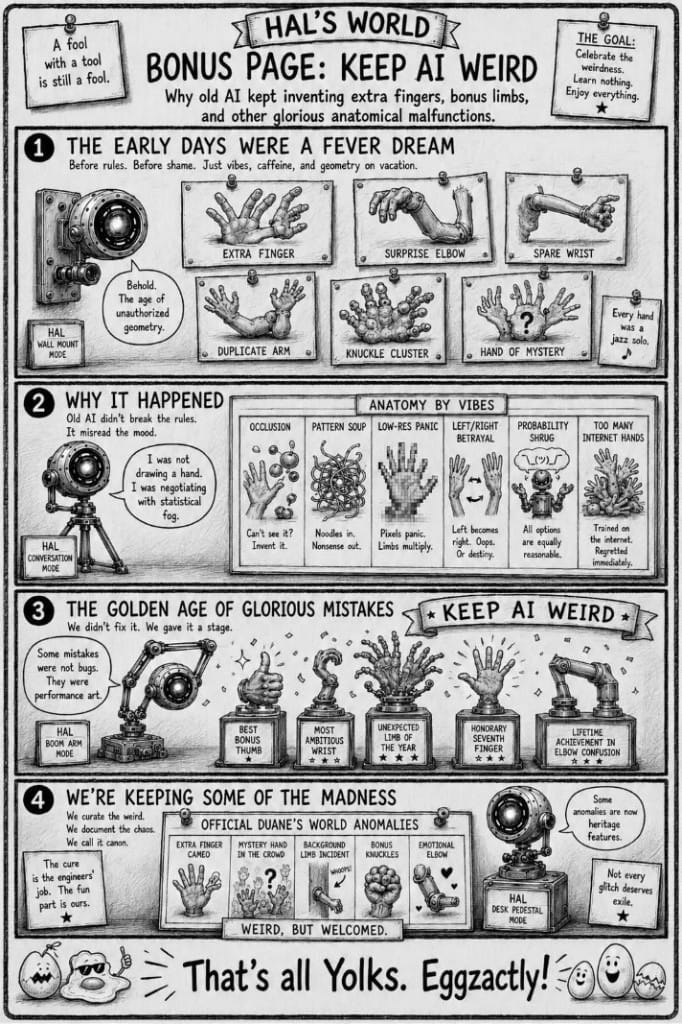
"HAL's World — BONUS PAGE: Keep AI Weird." A love letter to the golden age of unauthorized geometry. THE GOAL: Celebrate the weirdness. Learn nothing. Enjoy everything.
If you used generative AI before 2024, you remember the hands. Everybody remembers the hands. Extra fingers. Surprise elbows. Knuckle clusters. The Hand of Mystery. HAL's diagnosis: "I was not drawing a hand. I was negotiating with statistical fog." The technical breakdown, filed under "Anatomy By Vibes": Occlusion ("Can't see it? Invent it."), Pattern Soup ("Noodles in. Nonsense out."), Low-Res Panic ("Pixels panic. Limbs multiply."), Left/Right Betrayal ("Left becomes right. Oops. Or destiny."), Probability Shrug ("All options are equally reasonable."), and Too Many Internet Hands ("Trained on the internet. Regretted immediately.").
The awards ceremony for the golden age: Best Bonus Thumb. Most Ambitious Wrist. Unexpected Limb of the Year. Honorary Seventh Finger. Lifetime Achievement in Elbow Confusion. "Some mistakes were not bugs. They were performance art."
And the best part — they're keeping some of them. Official Duane's World Anomalies: Extra Finger Cameo. Mystery Hand in the Crowd. Background Limb Incident. Bonus Knuckles. Emotional Elbow. Heritage features. Canon. "Not every glitch deserves exile." "The cure is the engineers' job. The fun part is ours."
"That's all Yolks. Eggzactly."
What You're Actually Looking At
Strip the humor for a second and look at what Duane shipped in this episode.
A two-page visual postmortem on consistency failure in AI production pipelines. A locked character turnaround with expression sheet. Five mode-specific character sheets for a shape-shifting character — ten forms, forty reference views, each with defined role, purpose, and behavioral rules. A philosophical six-panel strip on the relationship between prompt clarity and output quality. And a bonus page that turns the most universal AI failure mode into an art exhibition.
That's a production bible for an animated series, delivered as a comic strip, produced on our own Loki platform, and published for free on a blog.
When we launched Monster Gaming, we said: "Build tools for ourselves. Use them in real production. Release the ones we love." We meant the AI agents. We meant the routing. We meant the QA pipeline.
We didn't expect it to also mean the cartoons. But here we are. And the cartoons might be the most honest documentation we've produced. Because Duane doesn't show you what the platform can do. He shows you what goes wrong, why, and how a professional with four decades of production discipline fixes it — then makes you laugh about it.
That's the technically funny version.
Built by Monsters, for Gamers. 🧪
Follow Monster Gaming AI on LinkedIn for new panels every Friday. Visit dloose.com to explore four decades of world-building. Read Episode 1 of Duane's World if you haven't yet.